Showing posts with label responsibility. Show all posts

Thursday, June 19, 2014

Favorite Deal of the Week: Laundry Detergent!

Well, with all the preparation for my new family life, I am working extra hard to work within a strict budget and search for the best deals!  This week, I found such a great deal on laundry detergent that I really wanted to share it with my Mom, so I'm posting it on my blog.  ;)

Here's the deal: liquid laundry detergent for $.04/ounce!!

Where: Walgreens
When: Through June 21, 2014
What: Purex Liquid Laundry Detergent
How to Score: Buy 1 get 2 FREE with Register Rewards Card

The cost at my local Walgreens was $5.99 for a 50 ounce container.  With this deal, you pay $5.99 for THREE 50 ounce containers, getting 150 ounces for $5.99, and thus spending $.04 per ounce ($6 / 150 ounces = $.04).  Additionally, you still receive register rewards points by using your card.  Double score!

The most recent "best deal" I found on laundry detergent was at $.05 an ounce for the same soap on sale at Publix, so I'm very excited about this!  It may even be worth another trip to Walgreens before the sale ends to get another 6 containers...

Happy shopping and happy saving!

The plans of the diligent lead surely to plenty, but those of everyone who is hasty, surely to poverty. - Proverbs 21:5

Friday, September 6, 2013

The New Leg of Our Journey: Crystal Laine


For anyone that has read my blogs throughout the years, you may not know that my writing extends beyond this website.  I have been writing music and lyrics for over ten years now, and praying for every line to be used in some way.  For an artist, to reveal artwork is a huge risk, because we make ourselves vulnerable to the world's interpretation of it in addition to our intention behind it.   At the same time, this risk is what makes artwork so beautiful and vibrant:  every perspective brings a new light to the artwork.

Without "too much, too soon," I'll share with you that I've ventured into this new journey with you of singing and songwriting.  I specifically titled this post as "Our" instead of "My" because - without a doubt - no artist does it alone.  This is so much more than "all about me".  There are countless people that fall into the category of musician, producer, encourager, promoter, listener, and prayer partner (to name a few).  All play a pivotal role in ensuring a message reaches the ears, eyes, and hearts of people worldwide and throughout the generations to come.

In the next few months, I'll be working with some local musicians (including Phillip Gonzales) and distant musicians (including my cousin, Zack Leffew) to polish and record songs.  I need your help in these ways:
  • Pray - For me, every administrative aspect of this dream's goal, people to be blessed by it, and for the people who *get* to deal with me ;)
  • Write - Send me a note to encourage me, ask specific questions about the music, or to let me know of the best calorie-free chocolate recipe you can find
  • Share - With your friends, family, online community, the doorman, the taxicab driver, and the neighbor's pets (to name a few)
Below I have just a couple links to my new social media sites where people can "follow" or "like".  Please pass them on, have no shame in sharing, and help me stay accountable on this journey.  I'm excited.  I'm challenged to new levels.  I think you will like taking this trip with me.  ;)


One final note: don't give up on dreams God has placed in your heart.  Trust Him and His timing, walk closely with Him even when you don't see fruition, and enjoy His presence every step of the way.

Soli Deo Gloria


Wednesday, June 12, 2013

Finding Opportunity in Boundaries

Several weeks ago I had the chance to visit a friend of mine.  We try to get together every few months and it's a fabulous time of reciprocal encouragement.  My friend, Phyllis, just recently was told by her doctors to switch to a new diet to see if it is beneficial for her.

In despair, Phyllis told me about this new diet restriction.  She lived most of her life in the Midwest as a farmer's wife, working hard to till the land, plant seed, cultivate, and harvest.  She knows mashed potatoes and fried chicken like breathing.  She knows all the goodness of a fresh apple pie and the buttery delight of warm biscuits and gravy.  But she's been told "no" to all of that.

Even with the food changes being made in this generation, change is never easy.  I understood Phyllis' frustration and yet I had to believe there was a better opportunity in this new diet challenge.  As we sat there, Phyllis showed me her list of ingredients that were "safe" and that she could eat on her new eating plan.  We concocted a recipe and went to the kitchen to start making it.

An inviting aroma wafted through the small kitchen as we started to cook the vegetables.  We talked about new ideas for recipe's that could be made with these same ingredients and we laughed at, truly, the opportunities that are revealed within this dietary restriction.

You see, if Phyllis had never been told to limit herself of what was comfortable, she never would have come up with these new ideas.  She never would have found out that she actually liked other things.


Often, God does this for us, doesn't He?  He takes us from what we know, what we're comfortable with, and He closes that door of opportunity.  We respond with frustration, usually; heartbroken at the reality that He has removed something we loved so much from our life.

What if....

What if He was actually cutting out those things that were toxic to us, that we could not tell were toxic??

What if He was actually moving us to a place where we could see an abundance of blessing that we have been missing all along??

Do you see where I'm going with this?  Let's take a new approach.  Let's purposefully look for the God-viewpoint and stay in that place.  It may mean coming across as insensitive at times, but done in love, it can be a gift second only to a saving relationship with Jesus Christ.

Let's explore the boundaries that God has given us with fresh excitement: He's not through with lavishing His love on us yet!


Friday, May 3, 2013

How to Win Every Day

Several months ago I had the privilege of talking with my friend who struggles greatly with a painful (and sometimes debilitating) illness.  She shared several creative ideas God gave her for raising her (now grown) children despite her illness, but one of them made me smile big!

"Crystal," she said, "every morning, I would sit down at the piano, and we would sing praise songs.  That way, if we got nothing else done that day, we would at least praise God."

What wisdom!

Over and over and over again, we are told in scripture to praise the Lord!  It matters not if you wake up and play a piano, play a song on your mp3 player, or make up a praise song of your own. What matters is this: that you praise God.

Praise can take on a lot of different forms (and that is an entirely different topic), but know this: when you start your day out praising God, placing Him as leader of your life, you win.  Immediately, you win.  You've put up a sign on your heart that says, "God is worth praise today, despite everything I lack."

Soon after my conversation with my sweet friend, I heard the song "You Are Good", sung by Kari Jobe on Gateway Worship's album Wake Up the World.  With lyrics like "Everyday I'll awaken my praise and pour out a song from my heart", I recommend this one for any morning routine.


Winning starts now.  Are you ready?

If you'd like more information on the benefits of praise, in great detail with scriptural references, I recommend this article by Watchman Nee.

**Leave me a comment below with your favorite praise song!**

Wednesday, March 27, 2013

Bloom Where Planted (A Reflective Entry on Nehemiah 05)


I was driving a friend to dinner one night and happened to have a conversation with her over the phrase “bloom where you are planted”.  You may have grown up with the phrase, like I did, but she is from a different country and was unfamiliar with the phrase. 

“Bloom where you are planted. Basically, it means to grow wherever God puts you. You know, like a flower blooms in the soil.”

Then, my friend made a very valid statement, “But sometimes, the flower dies.”

Ah, yes.  Sometimes the flower dies.  Sometimes the plant withers and the heart breaks.  Sometimes the dream is turned to dust.  Sometimes the walls are destroyed.  Let me be a little vulnerable here: sometimes I don’t bloom.  Sometimes my dreams are crushed and sometimes my walls are destroyed.  Sometimes, all the work of my lifetime that I have put into a task or a project is looked over and I’m left wondering, “What is left?”

Well, a fragment.  Fragments are left.  Nehemiah’s city was fragmented.  And what did he do with the vision God placed in his heart?  Nehemiah led his fellow countrymen (and women!) into a strategic plan to rebuild what was fragmented.  The key to their success was to take what was in front of them and build it up based on the threats that were specific to their part of the wall.  Each person was responsible for a little part, and their little part, in turn, helped fortify the whole city.

God has a vision for rebuilding us, too.  When you or I find ourselves left with pieces of a fragmented dream, or even a reality that went badly wrong, God will step in to redeem these fragmented pieces and build something even greater out of them, if we let Him. 
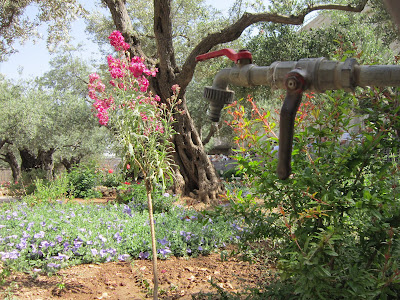
Garden of Gethsemane, Israel
May 2012
You see, sometimes the flower dies, but sometimes it only dies for a season.  Sometimes it just needs to be replanted into richer soil (like when you lose a job and are relocated), fertilized with the right nutrients (like when you become sick and have to cleanse your body of the sickness), watered (like when you are simply drained from life and need to take time to rest and recuperate), or placed in the right light (like when you have a bad day that helps you see a different perspective). 

Chapter 3 of Nehemiah shows us that God’s plan for our success involves not just where we’re at, but it is also about taking advantage of the other resources He has given us in this place.  Also, we learn that no success is found alone – there are always people surrounding us and God directing us.  As in blooming, I may be the best gardener ever, but God alone sees that the seed opens and life comes forth.

Blooming is not easy.  Blooming requires lots of growth, lots of change, lots of waiting, and lots of weather changes.  But this process also develops strength and beauty that cannot be found in a closed seed sitting in soil. 

Dare to pick up the pieces of what is left.  Dare to go to God with a fragment and work with Him as He rebuilds what has been broken and lost in your life.  Dare to bloom where you have been planted.


Questions for Reflection
  • What things in your life have been shattered (seemingly) beyond repair?
  • Can you see where God has had a divine purpose in allowing these things to happen?
  • How might God use your broken walls to draw people closer together? How might God use your broken walls to draw people to Him?  What makes the difference in bringing people together and bringing people to Him?
  • Are you willing to let God restore what has been lost in your life?
  • What is holding you back from daring to live a life of Christ-honoring influence in the place God has planted you?

Friday, March 15, 2013

Solid Ground amidst a Shifting World (A Reflective Entry on Nehemiah 04)


Wait. 

Wait wait wait wait wait…..!  Ugh!

Many of us struggled with this part of Lesson 04 of the Nehemiah study.  We share a passion to see things done effectively and efficiently in our world while still keeping a perspective of how things are affecting those around us.  But to tell us to wait?  Haven’t we waited long enough? 

Often, I find myself in the same boat as these amazing women: filled with a vision of destiny and yet so very limited by my “here and now” circumstances.  You may liken it to a paraplegic who was once an amazing athlete or a person in the throes of the aging cycle who used to be so independent.  Waiting can feel like a trap.  And acting on a whim can feel like the solution. 

But a whim fails.  Sure, sometimes you pull it off without a hitch and internally wonder “how on earth did I make that happen??” Most times, though, the whim is an immature response to our fear of the wait. 

What a great encouragement Nehemiah’s example was, then!  He waited in prayer before he spoke to the king, he waited in inspection of the city’s status, and he waited in sharing the king’s approval of his mission (Nehemiah 2:20).  Likewise, we can have freedom from lies that tell us we have to rush forward when we remember that restraint is not a bad thing.  Waiting helps us to see a different perspective while God works out the details. 
  • Details like officers and horsemen to protect you.  Nehemiah did not ask for them, but the King provided them anyways.  Earlier, Ezra needed them as well, but was ashamed to ask for them (See Ezra 8:22).  Despite Ezra’s shame and Nehemiah’s lack of shame, God provided.  God does not need us to come to Him with all our shame, but He does not turn away from us when we bring it to Him either.  In both circumstances, He provides exactly what we need.  And so we can confidently wait on Him. 
  • Details like opposition that is already in place.  Nehemiah likely knew of Ezra’s opposition when he tried to rebuild the wall years earlier, but he had no way of knowing what was to come.  Sanballat and Tobiah proved to be deeply threatened by Nehemiah’s attempts to rebuild the wall.  Nehemiah needed the confidence that God had sent him, not the king.  As the footnotes in my Bible read, “Knowing that God is behind your task is the best incentive to move ahead in the face of opposition.” Certainly Nehemiah’s preparation for this task showed that God was behind Him.  God will show us too, when we seek Him.  And we can confidently wait on Him for this also.

Sanballat and Tobiah were city officials, probably similar to mayors or governors as we know leadership today.  If the city was rebuilt, Sanballat and Tobiah would receive less money in taxes, which would be reason enough to be threatened by the welfare of the city and its people.  Even more threatening was the knowledge that the rebuilding of Jerusalem threatened their entire position of power.  Think about it – would you be more threatened by a decrease in pay or a possibility your job was going to be eliminated? 

Their response makes sense from a worldly perspective.  In order to survive in our world, we often find this threat creeping into our lives.  It may come in the form of competition in our workplace, jealousy in a circle of friends, or a broken economy.  Why?  Because the root of the problem is not work, not jealousy, and not opportunity! The root of our entire issue with waiting is security. 

We desperately want something true and solid to stand on in life, so we look to jobs, property, relationships, or wealth.  Every single time we are disappointed in the long run.  Everything we use to try and stand on aside from God’s truth fails us.  And I would challenge you with this today: it was made to do so!  Do you get that?  Our world was designed to collapse so that we would land on the one thing that does not shift for all eternity: God.  (See Hebrews 12:27)

All this from learning about Nehemiah’s wisdom in waiting… wow!  It’s hard to imagine how nearly 2,500 years ago there was a man living in a world so dramatically different than ours, and yet we can relate so intensely to his story!  That’s the thing: it’s not about Nehemiah’s story.  It’s about God’s thread through history.  He is the same yesterday, today, and tomorrow, and His truth applies to every generation.  Including ours! 

Jerusalem at Sunrise, May 2012


Questions for Reflection
  • Nehemiah’s waiting makes me wonder: what caused him to wait?  What life experiences caused him to stop and consider things before he acted on them? What life experiences have charged you to wait before you act on, or react to, something?
  • What things do you find yourself turning to when life gets tough?  Does this thing have a possibility of failing you?  How would you react if even that one thing crumbled?
  • What are some active ways you can choose to wait on God and seek Him for your confidence instead of other forms of pseudo-security?
  • Do you get annoyed or frustrated when you see insecurity in others?  Take time to pray for the people you know who are struggling with a very obvious form of insecurity. 
  • What vision have you had for your life that you are still waiting on God for?  Has He given you any direction to act on that vision?  Do you ever fear acting on something God tells you to act on for fear of not being able to tell what the result will be?  Pray for God to give you confidence to step out when He gives you a vision.


Tuesday, March 5, 2013

Scripture Notes: Mark 12 (Equal Sacrifice)

“Jesus sat down near the collection box in the Temple and watched as the crowds dropped in their money. Many rich people put in large amounts. Then a poor widow came and dropped in two small coins.

Looking south on the Temple Mount in Jerusalem.
These gates are the gates which people would have come and left through
when they visited the iconic city of Jerusalem to bring their
offering to the Temple.
Photo taken May 2012

Jesus called his disciples to him and said, ‘I tell you the truth, this poor widow has given more than all the others who are making contributions. For they gave a tiny part of their surplus, but she, poor as she is, has given everything she had to live on.’” -Mark 12:41-44 (NLT)


Many people get frustrated with the topic of “giving” in the church.  Understandably, to a degree, as it has been manipulated at times.  Even so, something that has been manipulated is not necessarily a wrong thing.

As human beings, we delight in a sense of security — having something to do, something to hold, something to call our own.  But is this Biblical?  I know of no Scripture telling us that it is wrong to have security.  However, if our security lies in anything but the sacrifice of Jesus, we have no real security at all!  Think about it — land and homes can be destroyed, friends and family have a free will that allows them to disrespect and disown us, currency burns and melts, and retirement funds can vaporize with a computer crashing or data erasing.  In a breath, everything we “own,” everything we “have,” can disappear.

Except for the gift of salvation.


  • Jesus’ sacrifice on the cross provided the home for us that will never be destroyed.
  • Jesus’ sacrifice on the cross provided a family for us that will never fall apart, that stretches throughout the earth and intertwines with generations past and to come.
  • Jesus’ sacrifice on the cross provided us with access to the hand of God, who owns the cattle on a thousand hills and so much more.
  • Jesus’ sacrifice on the cross provided an investment for us that out-spans retirement funds, trust funds, inheritance, estate, and income taxes.


Jesus provided it all for us.  Does it not make sense that we would take what little we have and invest in this plan?  The plan of salvation?  The way of the cross?

Yet, even with this justification, there is so much more to giving than just discussing material wealth.  As the widow understood, true wealth is seeded in the heart of sacrifice.  She gave what she had, though she had very little.  Jesus’ words about material wealth have so much less to do with letting go of material wealth than they have to do with having a heart of contented sacrifice.

A pastor I know coordinates hundreds of volunteers for a program that would be much less effective without their time serving.  His leadership plan includes this challenge: it’s not that you give equal time, but that you give equal sacrifice to the program.  One person may be able to give up more time a week than another, but there’s no comparison on our end.  Your sacrifice and your gift is a heart issue that is between you and God.

If you’re feeling pressured by the topic of giving, go to God.  Honestly ask Him for clarity in your own heart and mind regarding your perspective on sacrifice, and be willing to make changes in your attitude if necessary.

He has so much more to offer us, but we have to be continually willing to let go of things we hold onto so tightly so that He can replace them with even greater blessings.

Don’t be afraid of giving; instead, discover what you can give away so that you can keep receiving the abundance of what He has for you, starting with Jesus.


Sunday, March 3, 2013

Not-So-Secret Agents (A Reflective Entry on Nehemiah 03)

In accounting, we have a theory called "Agency Theory".  This theory is related to the legal term "Agent", which basically means "representative".  In Agency Theory, specifically, you have two parties: a principal and an agent.  The principal grants the agent the right to make decisions and perform actions on their behalf.  Like any other mutual relationship, the fact that you have two human beings with their own mind, will, and emotions, can cause conflicts.  Agency theory sets up guidelines on how to deal with these conflicts.  

It's not hard to see where thinkers in the past came up with this idea.   After all, when we are working with God to make His plans happen, we are agents of Him.  His Word, the Bible, is our guidelines on how to deal with conflict when we want to do something that may not align with His plan.  (See this idea here.)

Where we see an agency in Nehemiah
This week, we learned how God-centered prayer (communication) produces God-centered plans (action), and that God-centered plans succeed. Nehemiah gave us an example in this passage of how he was granted rights to make decisions and start a movement toward rebuilding the walls of his ancestor's city.  God was his principal, and Nehemiah was the agent.  But there is another principal in this story.  Rather, a psudo-principal.  King Artaxerxes played this role.  WorkTalk is an international workplace consulting website that I believe explains this relationship best:  
Don’t miss the symmetry here – every day Nehemiah went to work, the King also trusted his life into his hands – perhaps three times per day. The King had the power of life and death over all his subjects, but Nehemiah held the King’s life in his cup all the time. (WorkTalk)
Wow!  Talk about an agency.  There was a mutual dependence on each other to protect and look out for the well being of each other.  With this relationship, it seems hard to understand how Nehemiah could have any failure with his request.  However, the King was human too, and was subject to emotions and bad decision making just like any one of us. Nehemiah knew this and took time to plan and prepare for the possibility that the King would grant his request.

Sometimes, when an agent is representing a principal, they have to make decisions on how to act without consulting with the principal in real-time.  This is why there is such an emphasis on a good relationship.  This is also the situation Nehemiah found himself in when the King abruptly asks "What do you want?".  He has little time to consult his real Principal (God), and so offers up a quick prayer.  Nehemiah acted with tact and laid out his plans.  Wesley's Explanatory Notes tells us that the fact that the queen was present may have been to Nehemiah's advantage.  According to the commentary, " commonly, the kings of Persia dined alone, and perhaps because the queen expressed some kindness to him, [this] promoted his request."

Trista noted two very important things about the King's relationship with Nehemiah:
  • The King may have been more compliant because of the Persian government's way of quickly adopting the customs, religions, and economies of a conquered nation.
  • Clean running water wasn't as prevalent as it is today, and probably was not something that the King drank as frequently as we drink water.  This being the case, the King would have needed a pretty constant cup-bearer by his side.  This may not always have been Nehemiah, as a king could have more than one cup-bearer  but it stands to reason that Nehemiah was not just present only at meal times.

Manipulation
Some really good conversation was sparked by the quote that Nehemiah was wise in knowing how to "get the king's sympathy" before he presented his request.  This choice of words almost implies that Nehemiah was manipulative.  The historian Herodotus tells us that the Persians buried their fathers, and thus the appeal to the King was not to be misunderstood as manipulative, but it was personal. 

If I am speaking to a child, I may not effectively teach them about an economy by talking economics.  Rather, I would need to talk to them about addition and subtraction with use of toys or treats.  When communicating, our choice of subject matter depends on the audience, not just on the jargon of the subject.  Nehemiah was speaking on a subject the King understood; not to deceive, but to inform.   The King would understand that a city where Nehemiah's father's were buried was sacred, as this was the Persian custom as well.

Just like any situation we deal with, our words can be manipulative or we can stick to the truth.  Nehemiah showed he was not trying to be manipulative by the very fact that he answered the King honestly.  This sad countenance was punishable by death!  His honesty with the King, and the King's acceptance of Nehemiah as a confidant, not just a servant, showed the great respect the King had for him.  Nehemiah had proven himself through years of service: he demonstrated respect to the King, and the King was being respectful back to Nehemiah. However, the King still had the choice to sentence Nehemiah to death because of his countenance.  I like how this commentary puts it: "Nehemiah understood it was not his place to change the king’s heart. He prayed and left it up to the LORD, instead of dropping hints and trying to manipulate the situation. Then one day, four months later, the king’s heart was different. Are we making the mistake of trying to change someone else’s heart, instead of leaving it up to the LORD to do it?" 

Four months is a short time to pray for something.  Trista reminded us of this truth.  Historically, people would pray for years for an answer before God answered their prayers. Sometimes this is true for us as well. While Nehemiah prayed for only four months, generations before him had been praying for Israel's deliverance.  In the context of King Artaxerxes, four months was a relatively short time for a heart to be changed.  As much as we want to be molded into righteousness, even Christians have a hard time with heart-change.  This is our human condition, and why we are constantly depending on God for His power to change our hearts.

Why the Letters were Important
Nehemiah knew this same King had ordered earlier to not allow Jews back into Jerusalem to rebuild the city.  Ezra 4 (read it HERE - it really helps understand the severity of the situation!) explains this situation to us, and we see in verse 21 where it records the King's command to have the work stopped except at his express command. This is why Nehemiah needed the letters! It wasn't just to let him through the route to get to Jerusalem, it was his proof to any opposition that he was authorized to do the work.  It was his Agent's orders.  

Why the date given was important
Pastor David Guzik shares a neat relationship with the date quoted in Nehemiah and earlier Bible prophecy 
The date is also important, because it establishes the date given to restore Jerusalem and its walls. Daniel 9:25 says that exactly 173,880 days from this day - which was March 14, 445 B.C. - Messiah the prince would be presented to Israel. Sir Robert Anderson, the eminent British astronomer and mathematician, makes a strong case that Jesus fulfilled this prophecy exactly, to the day, entering Jerusalem on April 6, 32 A.D., precisely 173,880 days from Nehemiah 2:1.
The account of Nehemiah in this week's study kept bringing us back to the truth that we are all agents of Christ to see His kingdom established here on earth.  Our work and our efforts are not thwarted  by corrupt leaders or bad economic situations, because even our leaders are set in place by God (Daniel 2:20-23).  On the same note, we serve those in authority out of respect for God (Colossians 3:23). Our attitudes at work, toward our parents, pastors, community or government leaders are all truly our attitudes toward God.  (Gulp)  Yep.  It's a tough pill to swallow, but it's truth.  And truth always fertilizes the soil of our hearts to grow new, incredible things.  

Questions for Reflection
  • What decisions have you made in haste that were good ideas, but should have been restrained because the timing was off?
  • Nehemiah prayed and prepared fervently for four months.  What thing have you been praying and preparing for - for a long time - that you're still praying and preparing for?  
  • Can you recall a time when you made a successful appeal to someone in authority over you? Did you give yourself credit for being persuasive or for making a good case for what you wanted? Did you see God at work in your situation? (From Bible.org)
  • What dream have you had in the past that you have literally burned or buried in your heart?  Was it a God-dream? If so, what would it take to resurrect that dream?


Saturday, February 23, 2013

Judging a Book by its Cover (A Reflective Entry on Nehemiah 02)


I grew up doing musicals.  

Without sharing my life story with you, let it suffice to say that memories involving music, drama, or arts, always seem to stick with me.  One of the musicals I was in at some point in my childhood was called “O Me, O My, O Nehemiah!”.  The first thing I thought of when I heard about this Bible study was one of the predominant memories that remains of this fun little children’s musical: Nehemiah rebuilt the wall (see what I mean here if you are unfamiliar with what wall I'm talking about).

I say all of this to tell you one thing: the book of Nehemiah is so much less about the rebuilding of a wall... 

In fact, in all the peripheral research I did in personal preparation for his week’s group study, almost every resource I came to primarily talked of Nehemiah’s focus on prayer.   Prayer.  He was no engineer, after all.  He was a trusted, faithful leader that relied heavily on prayer.  For this reason, when we study Nehemiah, we may have to throw away some of our cozy childhood memories of our Biblical expertise and look at what the book really says.  We’re only in week two of this study, and still on the brief chapter one, but already we see a foundation Nehemiah builds in his life that has little to do with cutting or moving stone and a lot to do with relying on his communication with our Creator.

There are some very distinct truths that we can pull out of these 11 verses about Nehemiah, about our lives, and about prayer. 

We can pray with confidence!
As a God-follower (specifically now, a Christ-follower), we can have confidence in prayer.  Nehemiah demonstrated this confidence in that he knew the God he was praying to when he made his requests.  Nehemiah had a respect for God’s wonderfulness, he had a trust in God’s faithfulness, and he had a righteousness that taught him God was approachable.  Our attitude about prayer is often shaped by our attitude about God.  Nehemiah would have grown up learning about the attitudes toward prayer of Kings in his heritage, and one of them was Hezekiah.

Hezekiah prayed confidently to God in the same manner that we see Nehemiah doing so.  (See 2 Kings 19:14-19).  Hezekiah’s confidence was not just a boldness with the intent to flatter or manipulate God, but was to demonstrate his reliance on God’s faithfulness to keep His promises. We were reminded that prayer is not an opportunity for us to align God’s plan with our wishes, but as we seek God, our wishes are aligned to God’s plan.

Prayer brings success!
Do you see?  This is the answer to success in every area of life!  Prayer changes our heart’s desires to God’s desires.  God’s desires always match His great plan and purpose, and His purposes never fail.  Therefore, prayer always leads to success when we are seeking to have the heart of God, rather than seeking to have our own way.

God’s answers are immediate!

When we are praying for the plans and purposes of God to pan out, we can be confident that He has already answered those prayers.  Here are some examples: In 2 Kings 20, the prophet Isaiah came to tell King Hezekiah that he was going to die.  The King prayed as soon as the prophet left, and before Isaiah had passed through the courtyard of the temple (which was not very far at all-perhaps from your house to two doors down), God gave him the answer to Hezekiah’s prayer: “I’m giving you 15 more years to live.”  
Wow!  That's pretty immediate!
Consider also, Daniel and his prayer (see Daniel 10:1-14).  Daniel started praying and immediately God sent out the answer.  The angel sent to deliver the answer was held up for three weeks, though, and so Daniel kept praying.  Come to find out, Daniel’s prayers weren't just for an answer from God – they were for the delivery of that answer.  Do you get it?  When we pray, God answers immediately!  If we don’t see or know the answer immediately, we keep praying for the delivery of the answer!  God’s ready to dish out answers to prayer.  They are not as few and far between as they may seem, but we have a responsibility: act.  Pray.  Ask for what we need and then pray for a clear delivery of your answer while you praise God for what you can confidently trust that He has already done.

Prayer is valuable!
In verse 11 of Nehemiah chapter 1, we read that Nehemiah was praying with other people.   His request of God was not just to hear his prayers, but to hear the prayers of all the faithful people who have been in prayer.  Nehemiah was the spokesperson for his people at this time, but he was not the only person interceding through prayer for the Israelites and for the city of Jerusalem.  Sometimes we are in a place in life where we are a “spokesperson” – we are in the position and have the ability to speak up for that which we and others are praying.  But sometimes, we are the silent warrior, praying with other believers, expecting from our faithful God, but not necessarily writing a book about it or leading a movement for it.  Each prayer is vital.  Each prayer is valuable.  And no prayer goes unheard.

That “circumstance” in your life is your divine opportunity!
In fact, Nehemiah’s mentioning that he was a cup-bearer to the king wasn't necessarily as out-of-placed as it seems, initially.  The assignment of cup-bearer was a high honor bestowed on people that were loyal leaders and whose character had been tested.  This testing of character would have taken years, perhaps Nehemiah’s entire lifetime up to this point, but certainly before Nehemiah knew how God was going to use him.  Instead, while this verse states a fact, it also states a history: God had been putting this plan into place for a very long time!  His statement (in 444 B.C.) resembles the heart of what Mordecai spoke to Queen Esther approximately 40 years earlier (in 473 B.C.) – God has placed Nehemiah (like Esther) in the position and with the express ability to carry out a divine plan “for such a time as this” (Esther 4:14). 

You can take heart from this, because it is a truth that runs like a thread through the entire Bible, through the ages, and into the timeline of your life today: God has placed you in a position, and has placed in you the ability, to carry out His plan “for such a time as this”.  Your job is not a coincidence, your neighbors are not a coincidence, and your car troubles are not a coincidence.  All these things that shape our lives – the “dailies” that we have to deal with – are all part of the plan that God has in mind – and they have been that way forever!  Trusting, honoring, and following God during whatever you’re dealing with is your opportunity to jump into a divine plan and see restoration happen in your life and in the lives of those with whom you come in contact. 

Logic can be our biggest ally or our biggest enemy!
Often, we fall into “logic traps”, leading us to believe that an answer from God was really not from God at all, but was because “that’s just the way things naturally happen”.  While this latter statement is true much of the time, the reasoning behind it is not true.

When you cut your finger and ask for healing, God may use a salve to heal your finger, but the salve was not the healer.  The salve may have been the resource, and your application of the salve was perhaps the obedience required, but God is the one who did the healing, not the salve.  This is what we mean by logic traps.

Nehemiah didn't succumb to these traps, though he was certainly a wise man.  He chose to bring the details to God and let God work those details out.  His prayer was desperate and brokenhearted for the heritage of which he had only heard stories.  Even with these disjointed burdens, Nehemiah knew that God was big enough to ease his burden, in whichever way was suitable to His plan.  Like the heart of Nehemiah, let’s be mindful to thank God for each and every answer to prayer – even those we don’t physically see.  And let’s remember that while logic has its value, nothing surpasses the power or value that is held in the very being of God.

Despite a busy week and a late, exciting night of preparation the night before our group meeting, I was stoked to share these truths with the ladies!  In choosing to dive in and figure out more about exactly what we are reading, we found that while historical records intrigue and stories themselves can delight, seeking out deeper truths helps us to re-cover our perspective on this book of Nehemiah and to recapture the essence of what Nehemiah was really about: drawing closer to the heart of God. 


Questions for Reflection:
  • Have you ever had an event in your life that has caused you such great sorrow that you have wept for days or weeks?  What was it?  Did you take time to seriously pray about it?
  • How would you evaluate your current prayer life?  Is there something you would want to change?
  • Do you view prayer as a privilege, a job, or both?
  • Knowing what we know about Nehemiah’s divine placement in history (like Esther, like Jesus, like Moses), can you see how God may be taking you through places and seasons that could bring Him glory and bring you long-term goodness?  We cannot know which way the hand of God will move, but working to see our “hard times” through the eyes of eternity can give us hope in the short-term.


Wednesday, February 20, 2013

Scripture Notes: Mark 7 (Check Yourself)


“Jesus replied, ‘You hypocrites! Isaiah was right when he prophesied about you, for he wrote, ‘These people honor me with their lips, but their hearts are far from me.  Their worship is a farce, for they teach man-made ideas as commands from God.’  For you ignore God’s law and substitute your own tradition.’  Then He said, ‘You skillfully sidestep God’s law in order to hold on to your own tradition.’”  -Mark 7:6-9

I had a friend tell me once that her husband was cheating on her.

Then another friend.

Then another.

There was little I could do but pray, and pray I did.  My initial response was to be defensive for my friends, because I want to protect.  But my God-sensor told me to beware of being judgmental.  You don’t see what I see, He would whisper to my heart.

But God (I should've known not to start a prayer this way…), he is spouting Your name and Your principles off everywhere He goes!  How can someone who is doing something so blatantly against Your Word (cheating) proclaim Your Word (to be faithful)?

Of course, my defensive prayer was not surprising to God.

And His response?

You don’t see what I see.  You weren't there when I told the donkey to speak to Balaam (Numbers 22), or when I blinded Saul and renamed Him Paul for my glory.  You know that I don’t need a perfect person to work for me.  You know this, because you know you.  Despite your flaws (I've had many conversations with God about these), you make yourself available and I use you. 

If I can insert a hash tag, #epiccomplaintfail

Okay, okay, so I won’t judge.

Judging the person makes me just as guilty as them at that point because of what Jesus said in these very verses: I will find a loophole in God’s law to justify my own perspective for my own benefit or “to hold on to my own tradition”!

My responsibility lies in the same place as it had before my conversation with God: pray for them.  My job is to be Judge, not yours, He says.  Your job is to be in love with Me.  I’ll lead you down the right paths. Besides, this case is too big for you to handle.  Don’t worry, I've got it.

When we finally choose to worship God with our actions and not just our words, we will find tremendous freedom from the need to judge and justify.  And when we choose to check our actions against what the fruit of the Spirit (Galatians 5:22-23) should be producing, we will probably find the root issue of our surrounding problems.  As Jesus later said, “It is what comes from inside that defiles you.” (vs. 20)

Let’s fill our hearts and minds with the good fruit and uproot the bad that tries to defile us.  Let’s get back to the basics of Christ’s immense love for us and the sacrifice He made before we jump to the justification of our defenses.

Let’s practice a little more grace today.


Saturday, December 29, 2012

Mangers and the Hard Stuff


It wasn’t wooden.

In fact, it may not even have been covered.

It was certainly crowded.

It most likely wasn’t winter, and most likely was sweltering.

…on the night Jesus was born in Bethlehem.


Mangers in Israel during the first century weren't wooden.  They were stone – like this one…

Manger on the ruins of Mount Megiddo (AKA "Tel Megiddo")
May 2012

Chances are, Jesus was laid in a pile of hay (or feed of some sort).  Depending on where the manger was, it may not have even been covered, or maybe only covered with a small tent sheet.  Given that the shepherds were in their fields, it was probably late summer to early fall that Jesus was born, not the dead of winter. 

There are so many unknowns about the circumstances surrounding the birth of Jesus that could be debated over and over, but let me share with you my point: it wasn't wooden.  Jesus wasn't born into a cozy little warm stable on a cold winter’s night and laid in a soft wooden manger.  He came into a hot, sweaty, crowded town full of people registering for a census.  He was born to two tired parents who had just been rejected by society because of the possible “scandal” surrounding Mary’s pregnancy.  He was laid in a hard, stone manger to be displayed before visitors.  The manger never became “un-hard”, but the purpose of that manger was never greater than when Jesus was laid in it.

God took the Delight of eternity and stuck Him smack-dab in the middle of our crazy world in a hard stone manger.  He did it then, and has not changed His technique for all these years.  He comes smack-dab in the middle of our crazy, hectic lives and lays out His love on all the hard things with which we deal.  

Joseph and Mary dealt with a hard manger, a hard journey, a hard society.  We deal with hard questions, hard realities, and hard decisions every day. 

I deal with hard stuff every day.  But God has chosen to come right in the middle of those hard things and lay His Love out for me. 

...for you.

Jesus wasn't just a gift for Christmas.  He was a gift for every hard moment in our lives.  We choose to let Him stay in our mangers of the hard things.  What manger of your life can you lay Jesus in today?  The hard things won’t change, but they will finally have a purpose when we let God use them to show His love to a watching world.  

A watching world of 
kings… 
nobles… 
shepherds… 
innkeepers… 
presidents… 
children...
politicians… 
auto-body repair shop workers… 
hotel managers…
bosses...
the local deli owner...
parents...
neighbors...

Saturday, November 3, 2012

A Revelation of Change


Do you ever face so much change and challenges at once that you're not really sure what to think?

I'm learning so much right now that I can't hardly keep my thoughts straight.  I want to learn much, but the intensity of it is shutting me up - making me too humble to even talk about it until I can process it all.  There is big change going on inside of my heart.  At the same time, with all the pain and ache of change, I feel closest to God.  These are the times that give me strength for the "easy" times.  

I'm thankful for God's presence.  I'm thankful that I can speak the truth, whether I believe it or not, and that the truth sets my heart and my emotions free.  I'm thankful that God does not condemn me for all the faulty things I'm learning about myself.  Rather, He has convicted me of them so I can become more of who He designed me to be when He created me.  

Change is super-good.  But it's super painful.  I don't know how I'll make it through the challenge, but I always seem to do so somehow.  God in me is stronger than even I know. 

And this is why I choose to accept the change, the growth, that is being manifested inside of me:

"...when God has put His call on you, woe be to you if you turn to the right hand or to the left.  He will do with you what He never did with you before the call came; He will do with you what He is not doing with other people.  Let Him have His way."  (Oswald Chambers in "My Utmost for His Highest")

I want to be made into what God has for me.  It's not easy, but it's exhilarating.  What life can be truly fulfilled when it is not moving in the way it was created to move?  When can a heart be more rich than one that flows in it's designated purpose?  


Wednesday, October 31, 2012

From Vision to Reality: GCWS

Five months ago I sat in a hotel breakfast lounge on the west side of the Sea of Galilee.  We were getting ready to head out to a day of exploring the beautiful land of Israel near Tiberias.  My roommate and I were just enjoying our delicious breakfast when none other but our pastor, Pastor Dan Betzer, joined us at our table.  Wow!  What an honor!  To have someone you respect so much take the time to eat breakfast with you is something not soon forgotten.

We were glad to have him join us.  Not people to be shy, we included him in our conversation and enjoyed the humor he infused into it.  Then he hinted at a project he was working on, a vision, really.  Something that had been on his heart for a while but that God was just putting the finishing pieces together for it - and they were coming together quickly.  That was all.  He didn't share anything except that God was working out something big.

Now, if you know anything about Pastor Betzer, you know that God doesn't put small dreams in his heart. You also know that when God puts dreams in his heart, he doesn't see them as dreams, he sees them as goals.  The great lesson I've learned under Pastor Betzer's leadership throughout the years has been faith.  Faith, faith, faith.  Not that you can't have doubts, but that faith does not have to be swayed by doubts.

That being said, we didn't think much more of the conversation, and we enjoyed a magnificent day of touring on our dream trip.

Fast forward to now.  Much has happened, you understand, between then and now, to make now a reality.  But this was the work God was doing in Israel: The Great Commission World Summit.  It's like a huge fundraiser, yes: the goal is to raise $50 million in one night, November 2, 2012.


But that is just the tactical end of things.  $50 million represents millions of lives impacted by the saving knowledge of Jesus Christ.  It is not about the money.  It's about what will happen with the money.  It's about getting Jesus into the hands of people who have not yet heard of him.  A project like this has a ripple effect that will last for generations to come.

Consider Paul's challenge regarding sharing the good news about Jesus:

"But how can they call on him [Jesus] to save them unless they believe in him?  And how can they believe in him if they have never heard about him? And how can they hear about him unless someone tells them? And how will anyone go and tell them without being sent?  That is why the scriptures say, 'How beautiful are the feet of messengers who bring good news!'" (Romans 10:14-15)

 You can be a part of lots of things that help spread the good news about Jesus, and I don't discount one over this one.  This is just another opportunity, and I encourage you to be a part of it, whether by coming to the event on Friday night, or by streaming it live, or by sharing it with people you know.

For information on the project, you can visit their website here.


Let's show the world the incredible gift of Jesus!

Wednesday, October 24, 2012

The Weak, the Fatherless, the Poor, and the Oppressed.... and My Response


Defend the weak and the fatherless; uphold the cause of the poor and the oppressed. (Psalm 82:3)

The Team and I in Moldova, October 2010, working with Phillip and Chrissie Cameron at Stella's Voice

Tonight, some of my friends and I discussed the account of Israel in Judges 19.  It's a tough story.  It's the sin of the movie "Taken" in Bible times.  It's vulgar, painful, brutal, and ugly.  It's a modern day horror story.  

I have read it before, but life's twists and turns have given me a totally different perspective.  A big supporter and promoter of anti-trafficking movements and causes, I read the account last night and asked God: "What did this woman do to deserve that treatment?"

The answer? Nothing.  She didn't deserve the treatment at all.  

Then why?  I want to ask God this question.  OK, I did ask God that question.  "Why did You allow her to be used and abused like that?"  

My friend Phillip Cameron feels the same way about the ugliness of trafficking.  When telling his account of a girl named Stella (read the full account here), he says "I just can’t come to terms with the callousness and systemic wickedness that permitted such an awful thing to happen to anyone..."

I don't have the answer to this "why" question whether it is regarding this unnamed concubine, a girl in Moldova named Stella, or any other people that are currently being used and abused in hell holes all around the world.  All I have is anger for the act.  All I can do is pray for protection for those who are not protected, mourn for the hurting,  and beg God, in His mercy, to shut down the evil hand that compels those acts.  

My meeting was difficult tonight, because I came away with another perspective, but my heart still hurts.  My throat was still swollen with choked-back tears as I read the story with my friends again and thought of the people I've heard first-hand stories of in Moldova, in Florida, and in Ecuador, all on the brink of death after similar encounters with this evil.  

I can be positive every day and search for good in everything, but there is no denying the fact that evil exists in this world in very real ways to people I see every day.  Don't mistake my search for joy in life with my realization that this pain is a very, very, real thing to many, and it is not fair.  

So I have a choice.  Where do I go from here?  What do I do with this burden?  Well, I tell you about it.  I make you aware of this hidden, yet common, brutality, and that there is no excuse for the behavior.  I continue supporting and promoting movements, causes, and organizations that fight trafficking (see some links below).  And I look for every opportunity I have to stand up for the weak and wounded, while trusting in the power of God to apply justice where justice is due.

And until heaven, I do what I can to see others find freedom that, truly, cannot be found except by a miracle of an All-Powerful God.  

Please, PLEASE, help fight the cause of the weak, the fatherless, the poor, and the oppressed of our generation.  


Useful Sites:


(Thanks to Pastor Phillip Gonzales for his insight on the story in Judges...)

Thursday, July 26, 2012

Abortion, the Holocaust, and Salvation

Isaiah 1:18
Come now, let us reason together....

I'm not a fan of trickery or fooling people.  I'm very passionate about people knowing Christ and committing their lives to Him, but no change comes from deception.  This is why I so appreciate Ray Comfort's approach with people.  Give him a chance - he may come off as pushy at first, but you will see towards the end that he was only provoking conversation.  There's no commitment card signed by people in this video, only thought-provoking conversations that encourage people to make an informed decision in their own time.

I also appreciate his down-to-earth approach at the fact that we are all sinners - none of us are perfect, none of us are worthy of God's favor.  But we have a "parachute", we have a "bridge", we have a "lifeline", and that is Jesus Christ.

I encourage you to watch this video if you have not.  What are your thoughts?


Tuesday, July 10, 2012

Construction In Progress-Pardon My Dust


Pardon My Dust

There's a song we sang when I was little...
He's still workin' on me
To make me what I oughta be
It took Him just a week to make the moon and the stars
The sun and the earth and Jupiter and Mars
How loving and patient He must be
'cause He's still workin' on me...

There really oughta be a sign upon my heart
'Don't judge him (her) yet, there's an unfinished part!'
But I'll be perfect just according to His plan
Fashioned by the Master's loving hands.

Often times, I mess up or I do something not exactly the way it should have been done, and I sigh and sing that song to myself.  I'm constantly reminded that I'm not perfect, and that I'm not "finished" yet.  God still is molding and making me into His image! It's sobering and comforting at the same time. 

So if you know me personally, please exercise grace and mercy with me.  I know I'm not perfect; I know I'm still learning; I know there's a lot of dust during my construction.  Please pardon it.  And I will do my sincere best to offer the same back to you. 

I was quickened to write this thought after reading a devotional today.  If you'd like to read it also, which I would encourage, you can click HERE. 

Be blessed today - we've been given ANOTHER DAY to spend with God loving on each other.  Make the most of it!  :)